
The way we work with AI has changed fast. Historically, when we wanted to build something or learn a new coding language, we'd search the internet. Stack Overflow, textbooks, blog posts. Then in 2021, GitHub Copilot gave us our first peek into AI-assisted coding. By 2022, chat-based models changed the dynamic entirely. It was no longer about searching for information, but about the model explaining concepts to us and us building on that understanding. In late 2025, AI moved into our terminals with CLIs like Claude Code, Codex, and Gemini. And now, in 2026, we're in the agentic world. Agents don't just help us learn and understand anymore. They act on our behalf.
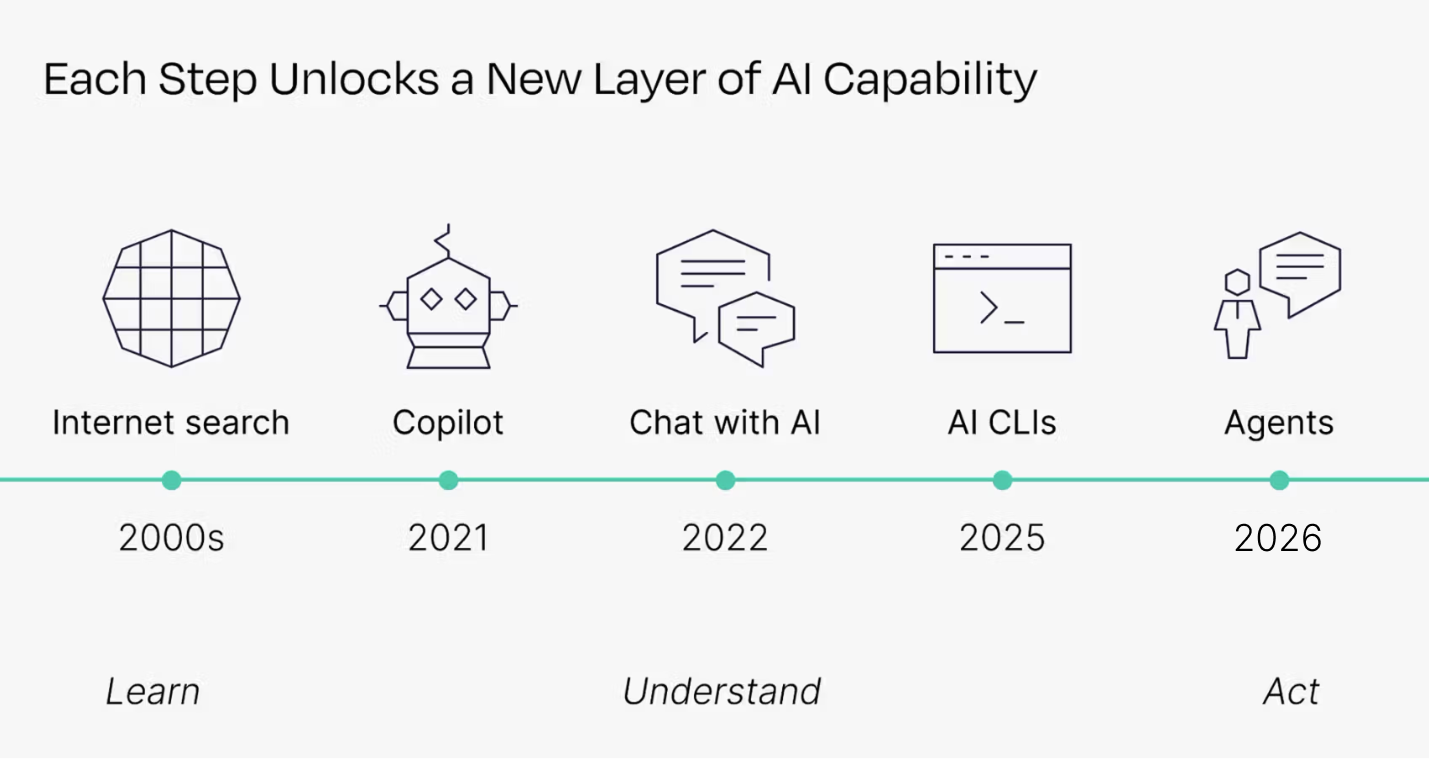
In this blog post, we show how we went from copilots to co-scientists in just six months with Nextflow and Seqera. We went from chatting with AI in a browser window to working alongside an agent that can help set up infrastructure, run Nextflow pipelines, and interpret results. Using a protein design competition as an example, we walk through what building with AI looked like, what it looks like today with Seqera Co-Scientist, and why the difference matters for scientific discovery.
The Chat Era - Building Pipelines in Your Browser
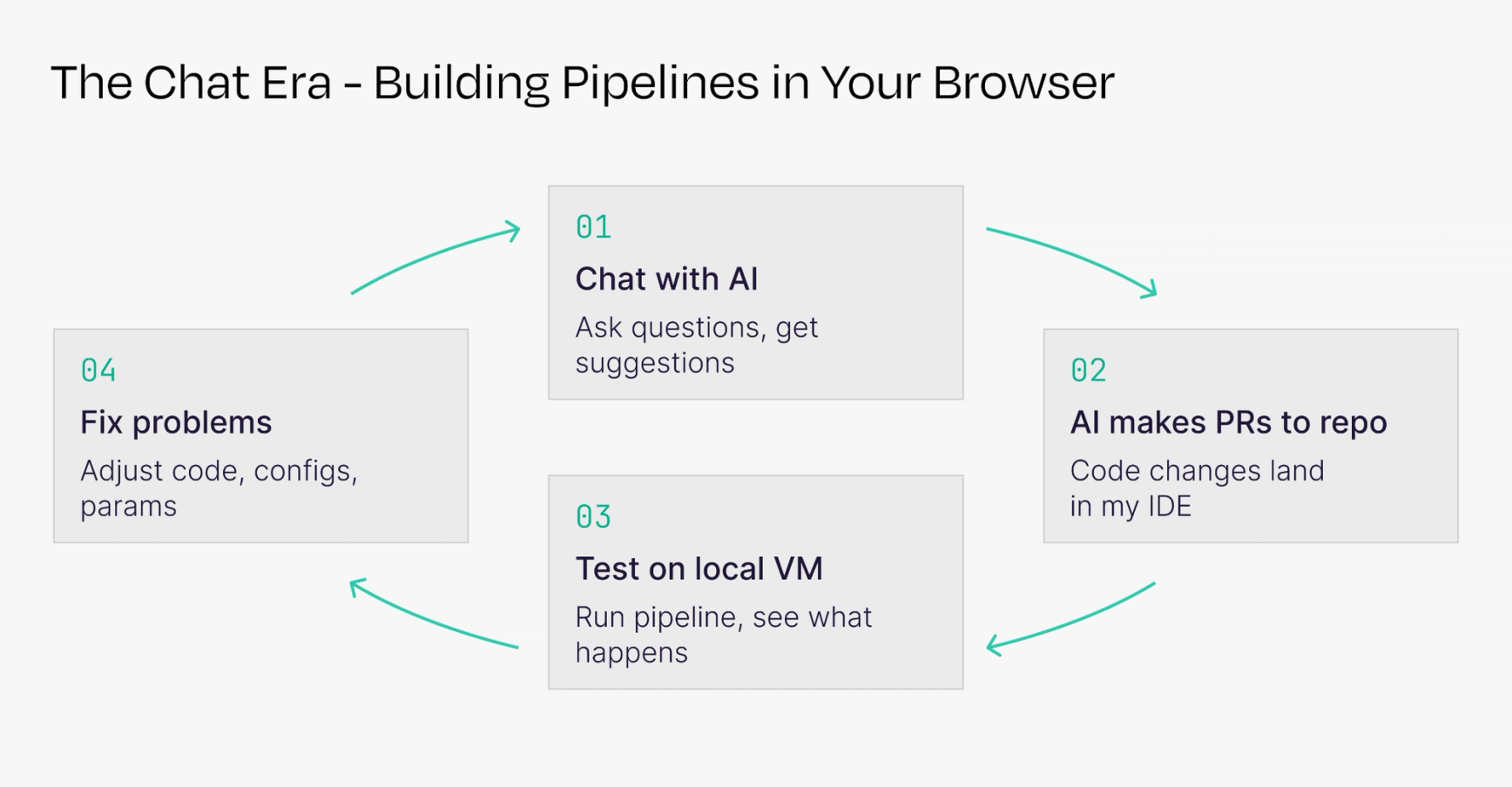
As part of the protein design competition, we wanted to build, test, and deploy a scalable Nextflow pipeline, utilizing Nebius managed Kubernetes and Seqera. To do this, we used AI in the browser alongside manual coding, testing on GPU VMs, and collaborative iteration. Here’s what the process looked like:
- Chat with AI - Ask questions, get suggestions. Start from a blank page and iterate fast on pipeline design and code.
- AI makes PRs to the repo - Give AI a Github token to your repo and it could make branches, commits, and PRs directly to the GitHub repository from a simple sandbox.
- Test on a local VM - Pull the branch onto a GPU-enabled VM on Nebius, run the pipeline, and see what happens.
- Fix problems - Docker issues, configuration errors, parameter tweaks. Push fixes, tell the AI what changed, and repeat.
Behind the science, the work fell into three interconnected areas: infrastructure, pipelines, and interpretation. Infrastructure meant standing up a Kubernetes cluster, configuring GPUs, and connecting credentials to Seqera. Pipelines meant writing Nextflow code, adding modules, testing on GPU VMs, and iterating on configs and parameters. Interpretation meant looking at outputs, comparing runs, and choosing which protein designs to prioritize. Without AI, this project would have taken months, and we might not have had a fully functional pipeline in time for the competition.
Agents Taking Actions
Back then, AI lived in a browser window. The coding happened on a separate VM. The AI wasn't living where we were doing the work. Context was constantly being lost between the two, making it harder to iterate quickly and keep the science moving forward. We launched Seqera Co-Scientist, the collaborative agent that understands scientific context, reasons with you, and executes with intelligence.
- →Infrastructure setup - Co-Scientist can help set up compute environments, including complex configurations like Kubernetes. No diving into specialized documentation or pulling a colleague away from their work. The agent finds the right settings and creates the environment for you.
- →Pipeline development - Co-Scientist can help write entire pipelines, add new tools to existing ones, check and validate pipeline code, and test end-to-end. Because the agent operates where the code runs, it can use specialized hardware (gpus, etc.), catch errors and iterate without switching between tools.
- →Results interpretation - Co-Scientist has the full context of your analysis and can reach across pipeline runs, pull in reports, examine outputs, and help you figure out which results to prioritize. No more copying data between tools or re-explaining what a pipeline does.
What makes this possible is context. Co-Scientist knows where things run (compute environments, cloud configurations, clusters), what happened (which pipelines ran, with what parameters, what the logs and lineage show), and what was produced (outputs, reports, metrics). All of that already lives in your Seqera account, and Co-Scientist has access to it. This is what gives it the power to be your agentic partner at every stage of scientific discovery.
Seqera Co-Scientist in Action
To see what this looks like in practice, let's revisit the protein design competition. At the time, we built the nf-proteindesign pipeline to design novel binding proteins against the Nipah virus glycoprotein G. Here's how the same work compares, with and without Seqera Co-Scientist:
| Without Seqera Co-Scientist | With Seqera Co-Scientist | |
|---|---|---|
| Infrastructure | Manually set up Kubernetes compute environment. Read docs, figure out SSL certs, control plane, storage claims. Message a Kubernetes engineer for help. Hours of back-and-forth. | Agent queried the cluster, created the compute environment, and ran a validation pipeline. Done in minutes. |
| Pipelines | Build pipeline iteratively over weeks. Chat with AI in the browser, switch to cloud VM, test, push fix to repo, explain to AI, repeat. Weeks for a full pipeline implementation. | Let Seqera Co-scientist iteratively add Nextflow modules, test docker images and pass nf-testswith human in the loop on the VM in under an hour. |
| Interpretation | Manually sift through outputs, copy CSV files between tools, compare runs side by side. Constant context-switching. | Agent reaches across pipeline runs, pulls reports, surfaces top candidates in a dynamic table. All in one interface. |
An Agent with Guardrails
Seqera Co-Scientist is an agent that takes action, but with guardrails. Whether it's setting up infrastructure, running pipelines, or interpreting results, Co-Scientist operates within the permissions already defined in your Seqera account: least-privilege credentials, scoped Personal Access Tokens, and role-based access. It cannot act outside those boundaries.
Traceable, Observable, Auditable
Same project. Same science. A different world, enabled by Co-Scientist. Seqera brings traceability, observability, and auditability to this new era of agentic science. Every action an agent takes is recorded, just like every action a human takes. Every pipeline run, every parameter configuration, every result, all captured in the same system. The systems we've built to serve human collaborators now serve agentic collaborators just as well. Scientists focus on discovery. Co-Scientist accelerates the path to get there.
Watch the Full Talk
This blog post is based on a Nextflow Summit talk by Florian Wünnemann (Senior Bioinformatics Engineer at Seqera). Using the nf-proteindesign pipeline as a running example, he walks through live demos of Seqera Co-Scientist setting up Kubernetes infrastructure, adding a new module to an existing pipeline, and interpreting results across runs. Watch the full talk to see Co-Scientist in action.