
A little over a decade ago, my co-founder Paolo and I built Nextflow. Today, it is the open-source home of computational biology, with tens of thousands of scientists using it every day and more than four million workflows running every month.
Through that lens, we have watched a decade of scientists pushing the boundaries of computation in service of discovery. In the last year, AI has driven acceleration like never before. For the first time, models can reason deeply about science, translate ideas into executable experiments, and learn from the results to pursue discoveries that were previously out of reach.
But the AI hype cycle often ignores a critical fact: reasoning alone is not science.
Scientific progress has always come from the combination of hypothesis and experiment: generating the data, running the analysis, training the models, and checking the result. Ideas are just the start. Experiments are how they become knowledge. It is by putting reasoning and experimentation together that you get a discovery loop capable of genuine breakthroughs.
Nextflow has long been the de facto computational engine for in silico experimentation in the life sciences. So, staring at the great rise of biochemical reasoning in AI, we have spent the last year asking ourselves: what would be the optimal system for combining advanced model reasoning with scaled computational experimentation?
Today we are launching what we built to realize this vision: Nextflow Frontier, a recursive closed-loop discovery system for the unsolved problems in life sciences.
The early results - as I’ll share a bit later on in this post - are remarkable.
Closed-loop discovery
We designed Nextflow Frontier for scientists. Give Nextflow Frontier a problem and a clear way to measure success. The system formulates ideas about potential solution pathways, turns these ideas into fully executable Nextflow pipelines, and then runs these “experiments” - often thousands of them - in parallel. It scores and analyzes the results. Then it learns and refines its approaches, and runs again. It can run autonomously for many days while staying fully guidable, verifiable and transparent.
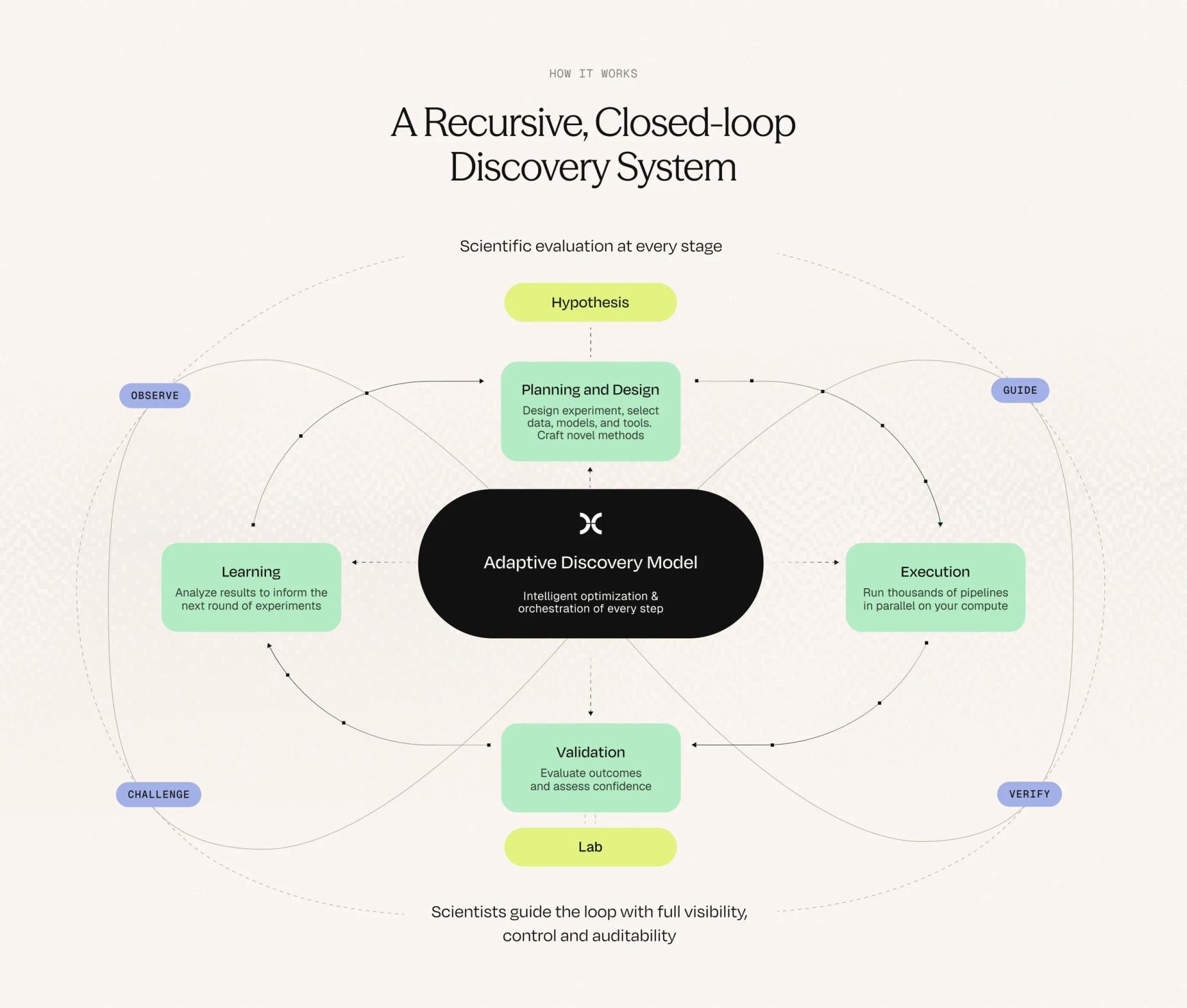
Nextflow Frontier is designed to be problem-agnostic and model-agnostic: it works on any problem that can be scored, using whatever model yields the best outcomes at each step. Nextflow Frontier has no preconception about how to solve a problem, which is what lets it trust the data and follow the evidence to learn. The system can combine models, invent novel methods, find unknown papers from other fields and uncover previously overlooked but scientifically significant datasets—all the things a brilliant scientist might do, but at previously unimaginable scale, guided by experimental evidence.
We have already seen remarkable success across many critical computational fields in life sciences:
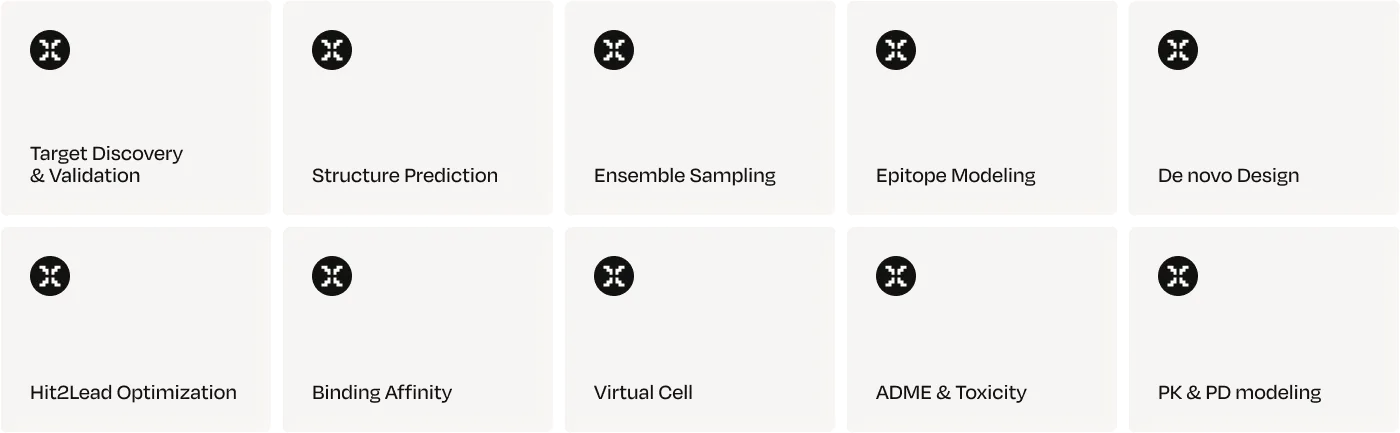
In a field recently dominated by the announcement of new, advanced models for specific computational challenges (a development we applaud), we have built, instead, the complete system for scientific discovery. Here’s the full stack:
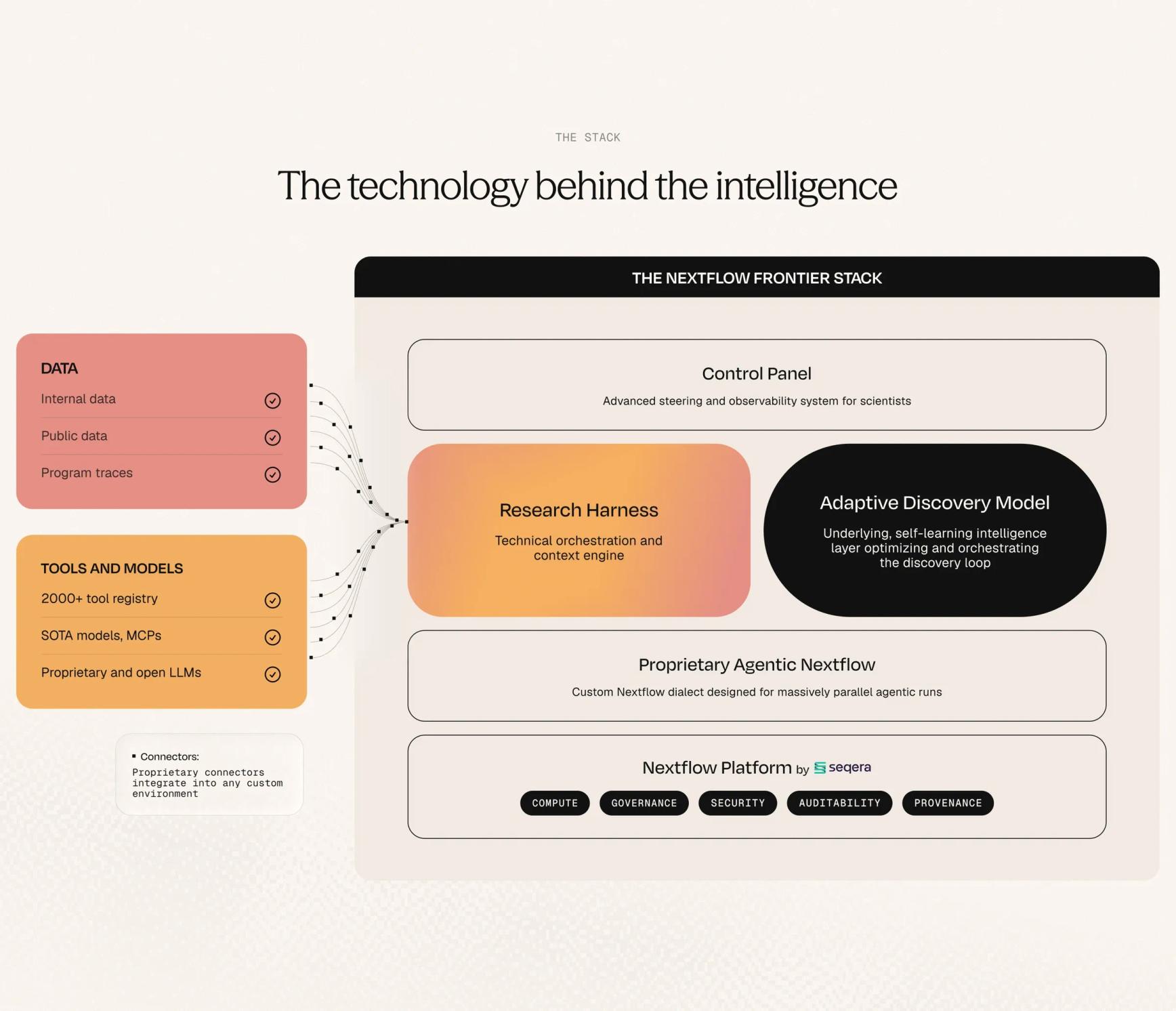
Key components:
- →The Control Panel - where scientists define the problem, follow progress and guide the loop.
- →The Research Harness - the operator, with dedicated agents for literature review, data analysis, and scientific software development. It turns each idea into a running in silico experiment, combines the right tools and models, stores context and state, retries what fails, records every decision, and orchestrates the entire agentic system.
- →Agentic Nextflow - a proprietary version of Nextflow built for massively parallel, long-running work that combines deterministic tasks and agents in a single workflow.
- →The Adaptive Discovery Model - the core of the system is an intelligence layer that plans the research, decides what to try next and gets smarter with every run. This is the intelligence that guides the intelligence, if you will.
- →Connectors - a complete network of technical connections to life sciences systems and models across internal storage, public data, public and private models, and wet lab operations.
- →Nextflow Platform (Seqera) - a comprehensive platform for operations inside life sciences companies - across compute environments, security and governance paradigms, and auditability requirements.
In a field dominated by agentic “auto-research” systems, we decided to build the language, the harness and the orchestration model - a comprehensive system optimized for actual scientific discovery. Other systems generate ideas; our system generates solutions.
Why Nextflow
None of this would work without the foundation of Nextflow, the best system we know for representing science as software. Containers, version control and data lineage turn a hypothesis into verifiable code. It is already where the science is. Fifteen of the top twenty pharmaceutical companies run our platform. Both Anthropic and OpenAI have recognized the importance of Nextflow’s infrastructure, with Anthropic integrating Nextflow skills into Claude for Life Sciences and OpenAI building its Rosalind Workbench entirely on nf-core pipelines.
Intelligence is new. The foundation is not.
Breakthrough benchmark results
We spent the past year or so building Nextflow Frontier, believing in its power but not yet knowing its full capacity. Then we tested it.
We ran Nextflow Frontier on BioML-bench: twenty-four tasks built on data from published lab experiments, across drug discovery, biomedical imaging, single-cell omics and protein engineering. Each has a training set and a test set whose answers the system never sees.
The previous best AI systems performed on average better than 75% of the leaderboard entrants - with variation by computational category. Nextflow Frontier has already delivered results better than 92% of entrants.
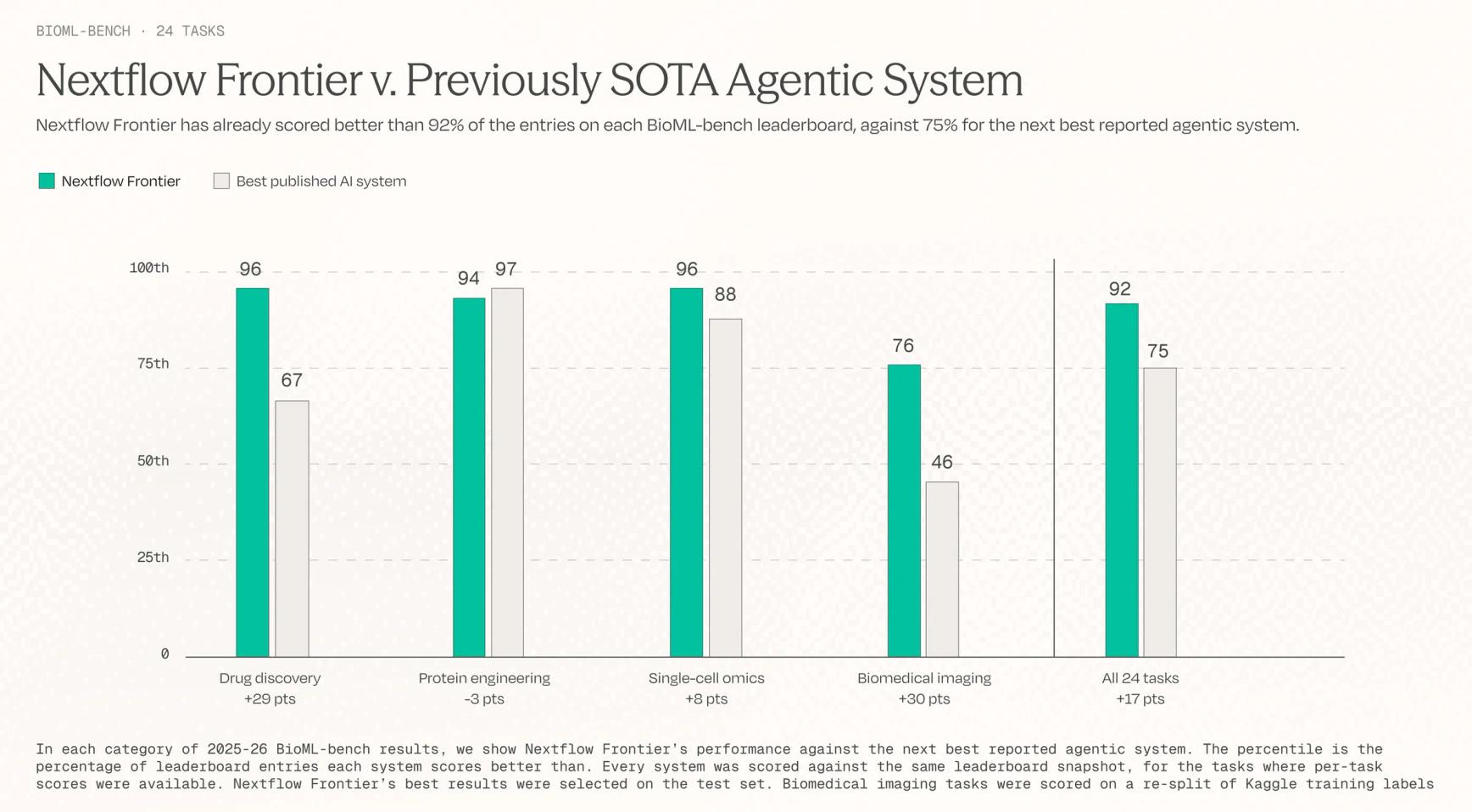
In every benchmark where Frontier is not the top performer, the system is still actively running. We expect to announce further progress in the next few weeks.
When looking at the level of individual benchmarks, we set the system loose on 24 benchmarks. We have already delivered top benchmark results (or the statistical equivalent) on 17 of these, and 7 are still running. We are launching Nextflow Frontier today by highlighting five winning runs that we think are particularly indicative of the power of the system.
What the numbers do not show are the surprising ways it got to the winning results. Take EGFR, a protein that can drive cancer when its growth signal runs too hot. We gave Nextflow Frontier the score, a blank canvas, and five hundred molecules already tested against EGFR in the lab. Another hundred and forty-four were held back. Over eighty hours it tried ninety-two ideas and ran eight hundred scored pipelines.
Using a chemistry model simple enough to run on a laptop, it kept pace with the best entry on the public leaderboard, which came from a billion-parameter neural network trained on specialist graphics processors. It got there by working out that if these drugs are anchored to EGFR by hydrogen bonds, what an atom can do should carry more signal than which element it is.
What I like most is the shortlist. Its top three picks from the 144 held-back molecules, the ones it ranked most likely to bind EGFR, all share a piece of chemistry with lapatinib, a known EGFR drug. These are from the test set, not new drugs.
We did not hand Nextflow Frontier a method. It found the method. And we’ve already seen remarkable success across many of the critical computational fields in life sciences:
- →Biomedical imaging. It outperformed a rebuilt version of the competition-winning approach at predicting how quickly lung function declines in pulmonary fibrosis, using a simple model instead of complex image-reading neural networks, on the same patients it was tuned on.
- →Single-cell omics. It named kidney cells more accurately than the published leader.
- →Protein engineering. A model eighty times smaller kept pace on protein stability.
- →Drug discovery. On a drug-metabolism challenge, it found a new path to predicting how quickly the human liver breaks down a drug, independently pulling in relevant rat liver measurements from the same public study rather than relying only on the benchmark data.
That is already playing out beyond the benchmarks. At ALLOX, Nextflow Frontier built a model predicting how mutations affect protein interactions that beat the published methods the team tested on their own held-out data.
“We gave Nextflow Frontier one of the hardest problems in our field: predicting how mutations change protein binding affinity. On our own held-out data, the model it built outperformed every published method we tested, including recent deep learning approaches. The scale of experimentation it enables changes what’s possible for a company like ours.”
André Faure
Co-Founder and CTO, ALLOX
What it delivers
Nextflow Frontier is not sold as software; it’s a partnership. Every project starts with a conversation: the team brings the question, the data, and a way to score success, and we bring the system and our forward-deployed scientists. The life sciences companies we partner with own the novel models and methods we deliver, and the pipelines that reproduce them.
We built Nextflow inside pharma, so we knew what the environment demands before we started. Nextflow Frontier is built to work inside the world’s most advanced Life Sciences companies.
2026 is the year that closed-loop agentic science really began. Real science has always involved the marriage of idea and experiment; but the computational scale and multi-dimensional orchestration and intelligence now available to us will yield an unbelievable acceleration in discovery. We couldn’t be more excited to contribute to this abundance.
How to work with us
We are actively partnering with a select set of advanced life sciences teams to use Nextflow Frontier. Please reach out and tell us about your hardest problems.