
Teams That Adopt AI Tooling Do More Science
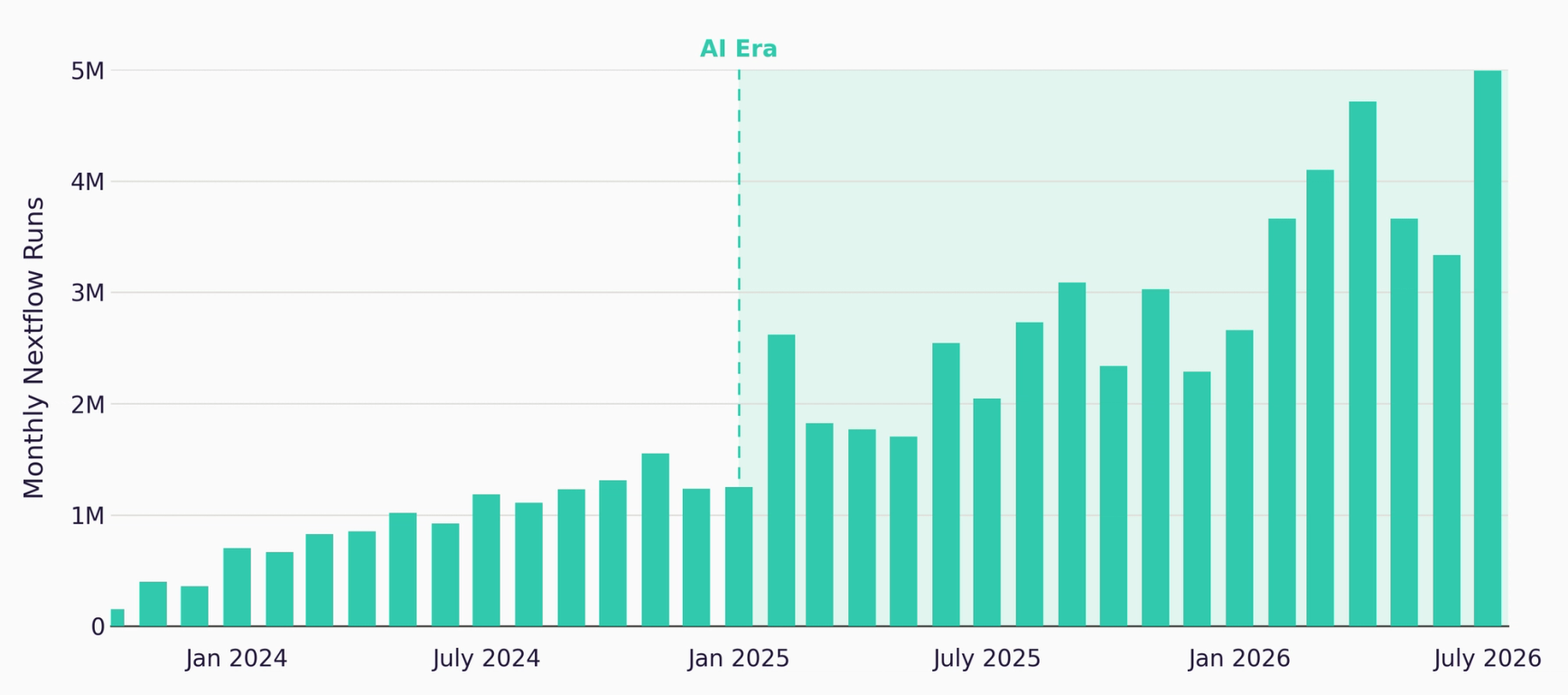
Before the AI era, teams were running roughly 1.2 million Nextflow jobs a month. As of August 2026, that number is close to 5 million. This isn't a 2030 hypothetical; it's a trend already underway. The guardrails covered in this blog (identity, budgets, verification, and reusable parts) are what let that growth stay something you can actually stand behind rather than something you're cleaning up after.
What Bioinformatics Will Look Like in 2030
Today, a lot of bioinformatics work still happens one question at a time. Data moves between teams faster than the context behind it does, runs get configured and debugged by hand, and throughput is really just a function of headcount and patience.
By 2030, we expect that to change. Multiple questions get answered in parallel. Work starts itself. Failures triage themselves and report back. Follow-up analyses chain together without anyone manually kicking off the next step. Throughput stops being about how many people you have and starts being about how many questions you can pose.
But more capability doesn't mean fewer problems. As agents take on more, three key challenges persist:
- →Is it wired to every input? An agent can only act on what it's told about. Sequencer drops, bucket events, repo pushes, upstream runs finishing. The wiring has to be exact and cover everything, or the gaps stay manual.
- →Can it heal itself? When runs outnumber the people watching them, most failures go unread. Agents need to triage and relaunch the routine stuff, and escalate only what actually needs a scientist's eyes.
- →How do you know any of it is true? Every output an agent hands you arrives in the same confident tone, whether it's right or wrong. At volume, not everything gets checked.
As output gets cheaper to produce, verification becomes the real constraint. Some things are cheap to verify: did the run complete, does the schema validate, do the checksums match. Others are only checkable against history: is this runtime normal, do the QC metrics sit where the last 200 runs sat. And some are hard to verify at all: is this signal or a batch effect, is this parameter choice defensible. Nothing exists to measure it against, and a wrong answer looks exactly like a right one.
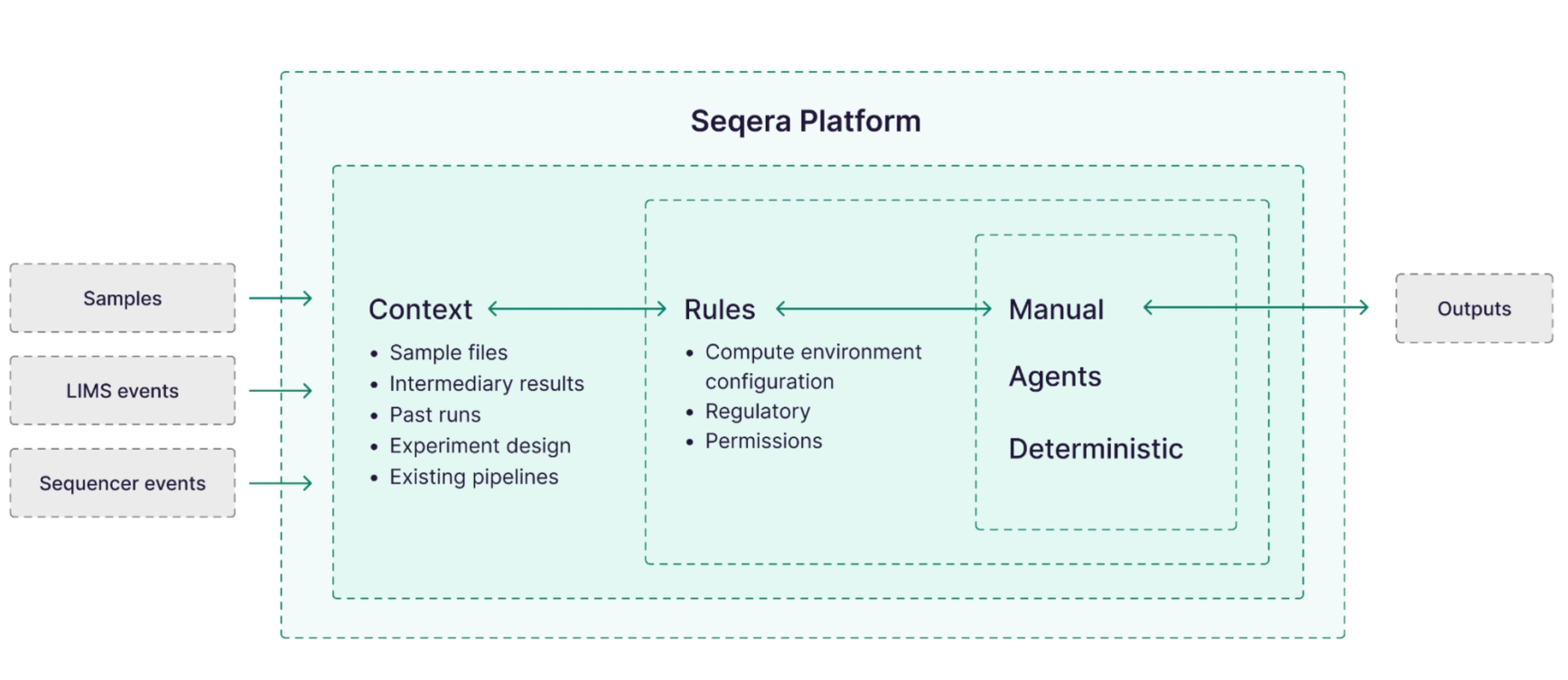
Whether the work is done by a person, an agent, or a deterministic pipeline, the needs stay the same: rules to govern it (compute environments, permissions, regulatory guardrails) and context to work from (sample metadata, LIMS events, run history). That's where Seqera Platform comes in.
Meet Seqera Co-Scientist
Seqera Co-Scientist is an agent built directly into Seqera Platform that can build and debug pipelines, launch them, and respond to external triggers like a pipeline status change, a GitHub event, or a new file landing in a bucket. You can reach the same agent three ways: from the terminal, from the web platform, or autonomously through configured triggers.
The core design choice that sets Co-Scientist apart from a general coding agent is what it does before it writes any code. Rather than generating pipelines from scratch every time, Co-Scientist checks your own module library first, then the Nextflow Registry, then existing container images, and only falls back to writing new code as a last resort. It's less about de novo code generation and more about assembling blocks from reusable parts that have already been tested and quality-checked by the community.
What makes Co-Scientist different from a general agent bolted onto your pipelines comes down to three things: context-aware debugging, a bioinformatics factory (where analyses are triggered automatically by events and built from tested, reusable parts), and accountability at scale. All of it runs inside your environment, on your data, within your compliance boundaries.
The Best Place to Debug
Debugging has traditionally been a relay race: you see a failed run with no useful error, ping DevOps, DevOps pings whoever wrote the pipeline, they ping whoever owns the cluster, and a couple of days later you finally get an answer. Four handoffs, and the context degrades at every one.
Because Co-Scientist is wired directly into Seqera Platform, it opens on a failure with everything that relay was trying to assemble already in hand: the full log and exit code, the pipeline revision and which module failed, the compute environment, and every prior run of the same pipeline for comparison. It answers with evidence, not a guess. In the webinar, we demoed this with a failed RNA-seq run with no clear error message. From a Studios session, we asked Co-Scientist to debug using the run details and log files, find the source of the error, fix it, and relaunch, all in a single prompt. Because the CLI has access to the exact scratch directory, task cache, and error files as the failed task, it was able to identify the root cause and get a corrected run going without anyone having to manually reconstruct the failure.
Why does this matter?
This matters most for the researcher who isn't a bioinformatician by training. They might build a working pipeline with an AI coding assistant, have it fail at 3am four steps deep in a container they didn't choose, with no way to describe what happened. What they can do is hand over the exact state of the failure, to a bioinformatician or another agent, via a Studios snapshot. Hand over the computer, not a description of it.
The Best Place to Build a Bioinformatics Factory
The second theme was automation that doesn't need a person to kick it off. Seqera Platform already emits three classes of events that agents can respond to without any custom glue code:
- →Pipeline statuses – a run fails and a triage session opens itself; a run completes and a follow-on job begins.
- →Code changes – a push to a pipeline repo revalidates it; a merged PR promotes the revision downstream.
- →Object storage – a sequencer drops FASTQ files and the run begins; a manifest lands and a whole cohort launches.
In the webinar, we demonstrated this by setting up an "Actions" trigger tied to a bucket event, pointed it at an agent with a simple instruction ("retrieve the full error log, inspect it, propose a concrete fix, and give a full summary"), and showed how that agent could then be invoked automatically on any failed run, or triggered again from the run's log page. Every session it kicks off is logged and viewable, so the automation doesn't come at the cost of visibility.
Why does this matter?
A factory runs on standard, reusable parts, not new code generated on demand. A general agent writes fresh code for every prompt; it compiles, it looks right, and nobody has tested it. Six months of that and you own a codebase nobody recognizes. Co-Scientist reaches for your module library first, then nf-core/modules, then a pinned container registry, writing new code only as a last resort, so when something breaks, it breaks somewhere your team already knows how to fix.
A Hundred Agents, and You Still Know Who Did What
The last piece is what happens once you're not running one agent, but dozens. Almost every agent in every organizations today runs on somebody's personal token. That drags along three problems: the agent inherits every workspace that person can reach, the audit log can't distinguish a human action from an agent's, and the automation dies the day that person's offboarding ticket closes.
Our approach is to give every agent its own identity: its own service account, scoped per workspace, read-only by default, with write access granted only where the job demands it. Every action is attributable to the agent that took it and revocable independently of any person. Spend caps (coming soon) extend this further, capping the token budget per session and the compute ceiling per agent so nothing runs away with your cloud bill.
Why does this matter?
It lets teams graduate agents through a trust ladder. Start read-only, triage bots, cost analysts, compliance auditors, none of which can write, delete, or touch a credential. Once you're comfortable, move to agents that act within tight bounds, like auto-retrying with more memory or launching pipelines on new data, each capped to its own narrow permissions. Templates, grants, and budgets are defined once and copied workspace to workspace, so the security review happens once per template, not once per team.
Seqera Co-Scientist vs. General-Purpose Agents
Not every agent option is built the same way. Judge any agent option by the same standard: code built from reusable, trusted parts; real knowledge of your platform state; autonomous action on triggers, not just prompts; its own scoped identity; work confined to your execution environment; and MCP connectivity to your other agents. Co-Scientist was built around all six of these.
| General coding agent | Build your own | Seqera Co-Scientist | |
|---|---|---|---|
| Knows nf-core and your module library | Guesses from training data | You build the integration | Built in |
| Knows your runs, environments, and spend | Starts from zero every time | You wire up the context | Always connected |
| Runs unattended between prompt | Session-bound | You build and maintain it | Configured, not coded |
| Agent identity, RBAC, audit, and budget | Runs as the user | You design the model | Platform RBAC |
| Executes inside your perimeter | Vendor-hosted | You run the sandboxes | Your deployment |
| Other agents can plug in, governed | Not governed | You expose the API | MCP |
Building for 2030
Agent-driven bioinformatics isn't coming; it's already here, and the volume of work will only keep growing. The teams that get the most out of it won't be the ones generating the most code. They'll be the ones whose agents debug with full context, build from parts that have already been tested, and act under identities that are scoped, auditable, and revocable. A bioinformatics factory that runs inside your environment, on your data, where every action can be traced back to the agent that took it.