From Nextflow Newcomers to nf-core Contributors: 48 Hours at the Natal Pre-Symposium Hackathon
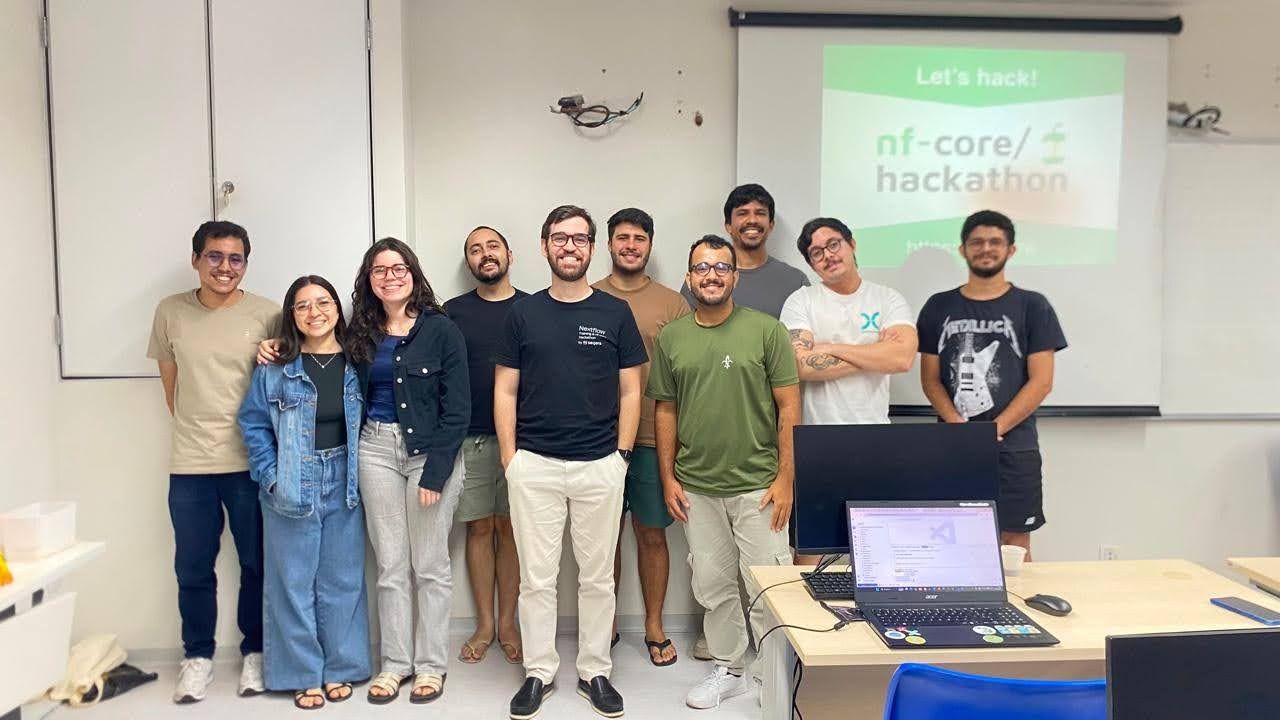
Serving as the preamble to the Simpósio Norte-Nordeste de Bioinformática (held August 17–21, 2026 in Natal, Brazil), our two-day nf-core hackathon brought together local researchers, students, and developers for a sprint of collaborative coding and open science.
Throughout the weekend, the atmosphere created a welcoming space where newcomers were introduced to Nextflow and quickly managed to submit their very first contributions, while returning developers leveled up in their Nextflow journeys. As participant Romério highlighted:
"At my last hackathon I managed to send a single pull request during the whole period, this time, with the team and the help of Seqera Co-Scientist, I managed to push through 4 pull requests, which felt much more rewarding". Romério Lima Filho, Hackathon Participant
Romério's experience highlights a growing trend: AI-assisted tooling is actively lowering the barrier to entry and accelerating the onboarding process for new contributors to the global Nextflow community.
Driving the nf-core Ecosystem
Across the 48-hour sprint, the team made significant strides on the nf-core ecosystem and local bioinformatics initiatives. On the nf-core front, a new module for BiG-SCAPE was authored and merged into the main repository, while a massive group effort tackled topic migrations for dozens of community modules, including tools like segemehl, rnaquast, samblaster, ska, seroba, s4pred, sage, spotiflow, star, tesorter, sam2lca, scimap, scramble, scanpy, tbprofiler, and slamdunk. Direct improvements were also contributed to nf-core/funcscan to support Bakta execution within MultiQC reporting, alongside a new pull request to nf-core/tools exploring Apple Container support for developer tooling.
Advancing Local Initiatives
Equally exciting was the progress on regional projects. The NetPerturb pipeline advanced substantially with the integration of hdWGCNA as a core feature, complete with comprehensive nf-test implementation and automated report rendering.
To ensure the momentum continues well past the symposium, the team also built and structured dalmolingroup/nextflow_training, a dedicated resource designed for short local introductory workshops.
Demystifying Open Source for the Local Community
Perhaps our biggest takeaway was seeing how quickly the 'imposter syndrome' of open-source contribution melted away. From afar, massive ecosystems like nf-core can feel like walled gardens managed by distant experts. But when you are sitting across a table in Natal, working through a GitHub pull request with someone who just did it themselves, the illusion shatters. The true success of the weekend wasn’t just the code written, but the realization among local students and researchers that world-class bioinformatics tools are shaped by anyone willing to jump in, and that includes our community right here in the Northeast of Brazil.
The Magic of Synchronous Debugging (The "In-Person" Value)
While our async community on Slack is phenomenal, this weekend was a powerful reminder of the value of synchronous, shoulder-to-shoulder debugging. Troubleshooting a complex Nextflow channel structure, configuring a tricky dependency, or writing your first nf-test snapshot can feel isolating when you're alone at your desk. But in a room full of peers, an execution error just becomes a shared puzzle. We saw experienced pipeline developers pulling up chairs next to complete beginners, turning hours of potential frustration into 10-minute whiteboard sessions. That kind of knowledge transfer simply can't be replicated online.
Acknowledgments
A massive thank you goes out to the institutions and individuals who made this event a reality. We are incredibly grateful to the Federal University of Rio Grande do Norte (UFRN) for providing such a welcoming venue for our 2-day coding sprint, and to Seqera for generously sponsoring the snacks that fueled the team throughout the weekend, as well as the Nextflow souvenirs for our closing raffle, where every attendee walked away with a well-earned piece of swag. Special appreciation goes to Prof. Dr. André Fonseca (UFRN) for his leadership in organizing the overarching Simpósio Norte-Nordeste de Bioinformática. Finally, a huge shoutout to Dr. Marcel Ribeiro-Dantas (Seqera), whose ongoing support and event-organizing expertise were instrumental in bringing this hackathon to life.