

I have spent years babysitting my bioinformatics pipelines. For the 5 years of my PhD and even before, during my masters, I would build a pipeline consisting of a tree of directories and subdirectories with copy-pasted versions of the same code that I would then tailor to the task at hand. Once created, I would submit each job array one at a time, and patiently wait for a success email. My mentor once described it as “a weird interest in self spamming”.
As you can imagine, this avocation to “jobsitting” soon became unsustainable when instead of processing one dataset at a time I moved on to processing data for 4 or 5 different labs with different variations of the same core pipeline. Yet, despite an unsuccessful attempt to automate my pipelines on my university's HPC, I stuck with my method and powered through the rest of my PhD.
It wasn’t until the last years of my PhD Nextflow came up in conversations, and over the last year and a half of my postdoc I have been devoted to learning it and translating my SLURM jobs into Nextflow pipelines. As with many things in bioinformatics, one can go from student to teacher in the span of a couple of YouTube videos, and that is what happened to me.
Soon after I started to learn Nextflow and talk about it with my team, I quickly realized there was a need to train my peers. Here I will talk about my experience with that training: what worked, what didn’t and some lessons I have learned about teaching Nextflow (or anything else) while you are still learning yourself.
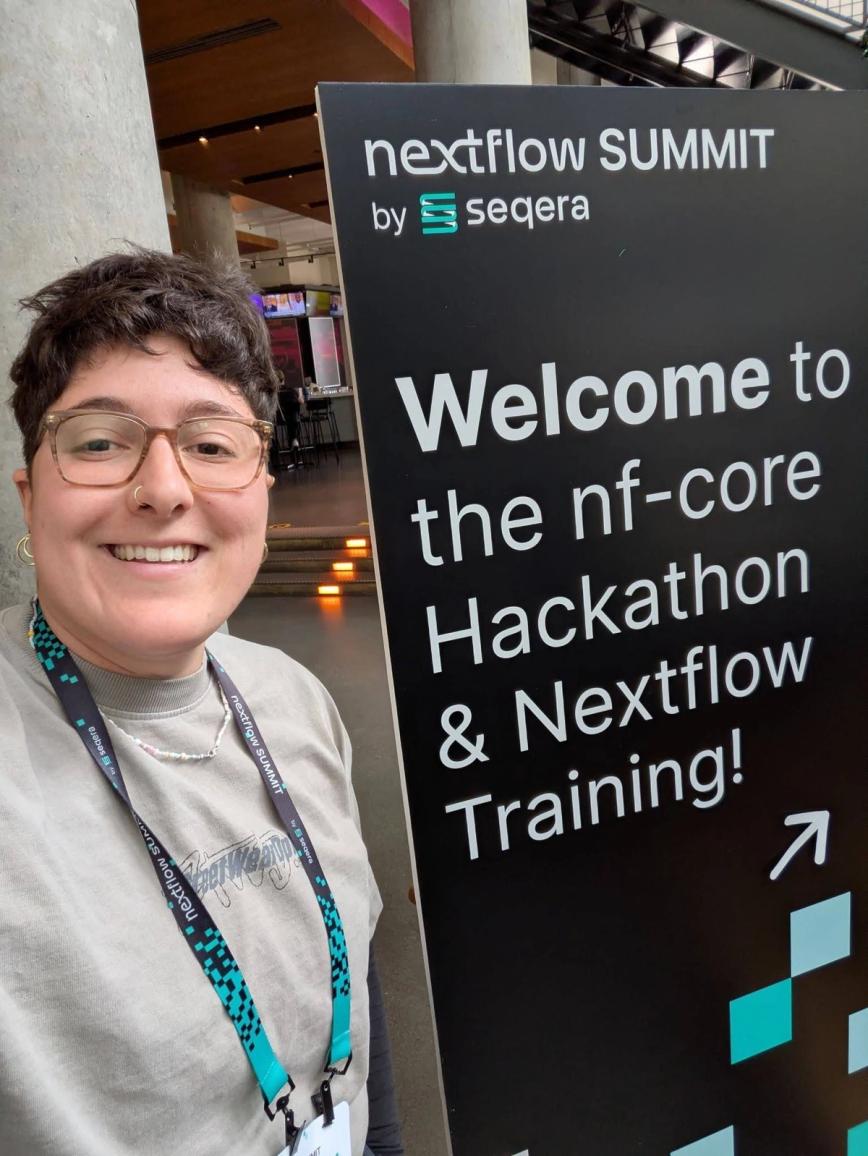
Disclaimer: Some time went on between my decision to teach Nextflow and the moment I put together and taught my first workshop. In that time, I went to the Nextflow Summit in Boston (2026) and became a Nextflow Ambassador which significantly helped me in my journey.
The Workshop
I am working at the Bioinformatics Research Center (BRC) in North Carolina State University (NCSU). My postdoc consists of many different responsibilities in both research and teaching. Part of my job is to research bacteriophage ecology, and part of it requires me to develop bioinformatics pipelines and train students, faculty, and staff on a range of topics from HPC, to ecological analysis with R, including using and building Nextflow pipelines.
Taking our audience (mostly academic and early career) into account, my team and I decided to put together a 1.5 day workshop.. We wanted to pack enough material to take people with a bioinformatics-adjacent background from little or no Nextflow knowledge to being able to create a basic pipeline. We also wanted them to be able to deploy their pipelines on our HPC system, and ideally have the intuition to start developing more complex pipelines for their own research. You can see the plan and materials for the workshop here.
The workshop was free to attend, in person on campus, and open to anyone in the North Carolina Research Triangle. We hosted a Day 0 a week prior to the actual workshop to get people set up with HPC accounts, basic commands and configurations. All in all people were happy with what they learned, although of course there’s always room for improvement.. In our post-workshop survey that all 10 attendees completed, self-assessed confidence jumped from roughly 1, on a scale of 1 to 5, to an average of 4 across all topics. On top of that, 8 participants planned on using Nextflow over the coming three months, and 9 said they would happily recommend our training to others.
Let me cut to the chase and tell you what worked, what didn’t, and other topics that were hard.
What Worked
- →Because I am also learning, I was able to identify topics that are especially confusing or hard to understand when you first start learning Nextflow. I dedicated extra time to those concepts and saw positive results.
- →Having people from different backgrounds and different levels. I know this can sound like a challenge, and it is if people expect to be catered to their level. But if you make it very clear from the start what the workshop is about and what people can expect, if someone that knows more decides to attend, they can become an asset for troubleshooting (this is more the case when teaching in person). I recommend having some coworkers be your teaching assistants to ensure this. In the feedback survey I found out that only 3 of the 10 participants came with a specific project in mind; most came for career prep, curiosity, or both. That mix led to a room more forgiving of different paces.
- →Using very thorough materials that people can take home with them. This removes some pressure off the actual workshop, and makes people feel like they can enjoy it without worrying about remembering everything. This came through in the survey too: people singled out the materials and the amount of help available.
- →My work has benefited greatly from this. I have learned the basic concepts of Nextflow to an extent I would have not if I hadn’t had to teach it. I also got to spend more time than previously planned reflecting on some of the design decisions I had made for my own pipelines, which I think just leads to a higher quality of my work.
What Didn’t Work
- →Everyone’s first attempt at running Nextflow. Turns out the first time you run Nextflow in a system you need the internet. Our compute nodes at the NCSU-HPC don’t have internet access. So in the first hour of the workshop I had already lost my audience to their error messages. I missed this bug because it had been a long time since I had first run Nextflow on the HPC myself. This is why it is important to have someone with no previous experience on the system to test the materials before the workshop.
- →Having everyone work on the HPC can be quite a challenge. People with the same exact code would sometimes find themselves in very different situations: jobs stuck in queues for a long time, jobs coming back with empty results, while other jobs run so fast the user doesn’t realize it was even scheduled and successful. If people are working on different HPCs, then this gets even harder. In this case, running Nextflow on the HPC was the goal of the workshop, so there is no way around it. If your goal is to teach Nextflow itself, I might recommend starting locally to ensure the participants can learn the basics without distraction, and then moving on to a more complex system like the HPC.
- →Planning for >25 and getting 10 attendants threw me off. We had >25 people registered and 10 people attended. We finished everything faster, so I could have added more material. It made it feel like I was underprepared, even though everyone was happy to have some time back!
What Was Hard
- →I was insecure with some of the material that I haven’t had the chance to try for myself extensively and it showed. For example, one weakness was channel operators. I felt this lack of confidence in my presentation, and in the survey, where confidence in this skill barely moved.
- →Deciding how much to let people struggle. I built intentional errors into some of the exercises, because so much of working with Nextflow is reading error messages and figuring out what went wrong. I wanted people to practice failing with help nearby. The survey was split on the value of these intentional errors: some attendees found it useful, and others found it frustrating. Looking back, I think it depends on timing. An intentional error lands differently when people have already spent the first hour fighting real ones (see: compute nodes without internet). Next time I’d keep the intentional errors, but introduce them later, say upfront that they’re coming. This will make it clear they’re part of the exercise rather than something people did wrong.
- →Balancing theory with practice and still ending up with a functioning pipeline participants can take home. Nextflow has levels of complexity that you can get lost in. This is especially true when you are also learning and developing, these details can take a front seat where they wouldn’t normally have. The capstone was rated the hardest section alongside the channel operators, suggesting that getting everyone to leave with a working pipeline, although probably one of the main reasons people signed up for the workshop, can add pressure.
- →Simplifying. I don’t know about you, but my Nextflow pipelines tend to grow overly complicated (profiles, variables, configs on configs). Taking the work I have been developing for my own pipelines and distilling to what people actually need to be self-sufficient was a challenge.
Lessons Learned
It takes a village
I couldn’t have done it without my team. I had help with all the administrative tasks (registration, booking the room, catering); with the Day 0 pre-workshop setup session, which was taught by a graduate student; with the systems administrator side (getting all the tools as containers, making the data accessible to all); and with reviewing the materials with my team for feedback, to allow for better decision making and distribution.
Offer pre-workshop setup help
Doing a Day 0 prep allows you to get an idea of the audience’s level, do it a week before so you have time to modify or prep based on it. If possible, have someone else teach it so that you build your team’s expertise and at the same time observe the room without having to manage it.
Choose your audience
So that you have something to teach them, but if they know more of something, welcome it. One day not so long ago you were starting your journey, and you had little to no knowledge on Nextflow (or whatever topic). At the point the idea of teaching remotely crosses your mind, you either have had time to progress in your own learning journey or you are planning on having it. That time you put into the material is more valuable than you think, especially when you already have in mind that you will teach. Try to focus on those folks that are currently in the early days of their learning, you will provide the support you wished you had had!
Go for clarity rather than depth
If you were able to make it work, then you can show them how to make it work. But don’t give in to the temptation of explaining all the nuances right away. Filter out whatever is not essential in the first instance and try to distill only those things that will make it or break it. However, people can take more complexity that we normally allow ourselves to believe when we are preparing a workshop, and they often welcome it! Read the room, and only embark yourself on tangents you can deliver on.
Test run!
Things are going to fail on the day of the workshop, that is the name of the game. But the less things fail the better, especially if like me you want to use intentional errors. The only way to prevent failures is to test. But also accept that it will happen and you will have to react on the spot! Maybe ask some people for help assisting, so you don’t have to confront it by yourself.
Create a relaxed environment
This helps lower the pressure on yourself which in turn lowers the pressure on the participants (they are learning, you are learning, you just learned some stuff before them). Personally I make myself vulnerable: if I am nervous I say it, I tell them why, I try to connect it with the experience they will have learning the material. Why was I nervous about teaching this Nextflow workshop? In part because I am learning myself, in part because Nextflow has a lot of nuances and the learning curve is not trivial. Once I opened up about this in this last workshop I felt the room immediately ease up, we all were on the same level, and learning became a collective activity.
Wanting to do it is 90% of it
Sometimes wanting to be a teacher is all it takes to be a teacher. There will always be people that know more than you, but you have put in the work to teach whatever it is you are learning. Not only was your learning experience informed by your need to teach, which already means you have interacted with the materials in a more profound way; but also, you are putting your time and energy into it, and that is plenty.
Just do it
Teaching is a lot like learning with a group, especially when it comes to modern technologies. By teaching we are also creating a learning community, so despite the hesitations and insecurities that might come from teaching while learning, it has value.
In Conclusion
Learning with the goal of teaching changes both the learning and the teaching, and I’d say for the better.
The clearest example from this workshop is channel operators: this was the part I was least comfortable teaching, and it was also where attendees’ confidence moved least, becoming the top of the list of what they want to learn next. Although it is always hard to confront the evidence that you could have done something better, I don’t read the issue with channel operators as a failure. It evidences where we all are, me included, and of where to go next. So that’s my plan: spend more time with channel operators in my own pipelines, then come back and teach them better.
During the workshop I also had several moments of thinking, “Wait! I need to tell them about this detail that I learned while test running this script!”. In those cases my teaching was supported by my learning experience, and I was able to provide first hand knowledge that is very hard to get otherwise. At the same time, the concepts I focused on and the way I structured my learning process always had the ultimate goal of producing the best quality of materials. I went on numerous tangents to make sure I fully understood what I was doing and why, and how to answer the questions I could imagine people asking. Through those tangents I made great progress of my own. In that way, my learning was fueled and improved by the teaching goal.
So this is my message: If you’ve been waiting until you feel like you know enough to teach something, my advice is not to wait. Teach what you know, be honest about what you don’t, and learn the rest alongside the people in the room with you.