
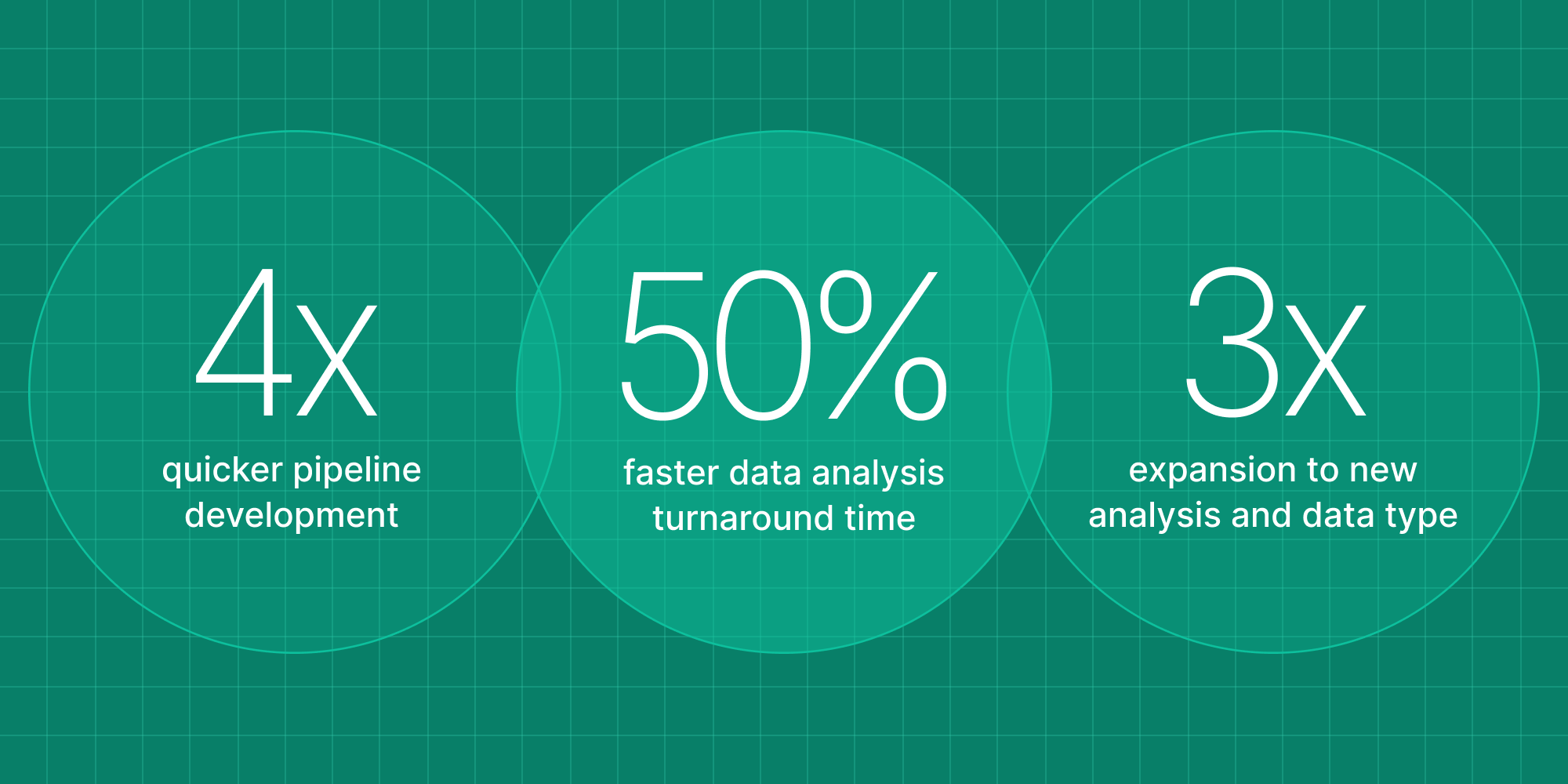
In the fast-paced world of computational biology, efficiency and reproducibility aren't just nice-to-haves, they're essential. Here, we showcase how a life sciences organization transformed their operations with Nextflow and Seqera, to achieve a 50% improvement in data delivery time and 4x faster pipeline development.
The Objective: Modernizing Bioinformatics Operations
The organization set out to transform how they support R&D initiatives:
- →Efficiently process and analyze NGS data and generate reports for collaborators.
- →Implement technologies that increase efficiency, reproducibility, and knowledge transfer.
- →Flexibility to answer any scientific question efficiently while maintaining high quality.
The Challenge: Scaling Bioinformatics for R&D
The organization's bioinformatics core serves as the computational backbone for R&D initiatives. Their mission: ensure reproducibility, scalability, and efficient knowledge transfer across the organization while analyzing data from both established and emerging technologies to efficiently address scientific questions without compromising quality.
But like many growing life sciences companies, they faced critical bottlenecks:
- →Limited computational space that allows frequent pilot processing, analysis, and visualization.
- →Shortage of dedicated personnel to build and maintain specialized computing environments.
- →Budget constraints that restricted investment in infrastructure and specialized personnel.
- →Increasingly complex R&D projects that outgrew existing systems
The team was pioneering novel technologies where standardized tools and pipelines didn't yet exist. Before implementing Seqera, the team utilized institutional environments or local systems for testing. As project complexity and data volumes grew, these approaches couldn't scale. With limited budget and no specialized personnel to build the necessary computational infrastructure, finding a cost-effective solution became crucial.
The Solution: Seqera for Scalable Bioinformatics
The organization implemented Seqera, the comprehensive platform for scalable bioinformatics, combining community-driven pipeline standards with enterprise-grade workflow management capabilities:
- →nf-core: Modular, scalable, and portable Nextflow pipelines, standardized to ensure reproducibility across projects and teams
- →Nextflow: Custom pipelines in cloud or on-premises to process sequencing raw data to molecular abundance information and genomic track records.
- →Seqera: Centralized platform to manage pipeline execution, monitor workflows, perform statistical analysis, and generate reports at scale
- →Studios: Interactive analysis environments providing seamless access to Jupyter and RStudio notebooks, VS Code IDEs, and remote desktops for rapid tool testing and collaborative exploration.
Business Results
Standardization of Data Analyses
The team leveraged Nextflow to build standardized pipelines for pilot data processing of novel technologies, ensuring reproducibility across projects. Additionally, they adopted nf-core pipelines, including rnaseq, chipseq, cutandrun, and atacseq, with optimal parameters to process standard incoming data. To further enhance standardization, the organization implemented Seqera for stable execution of Nextflow pipelines at scale, ensuring accessibility for the entire bioinformatics core.
“The collaboration between Seqera, Nextflow and the nf-core community is revolutionizing the bioinformatics field by allowing experts to concentrate on discovery instead of infrastructure maintenance. This partnership is also paving the way for other fields to seamlessly apply bioinformatics, broadening the horizon for innovation and research.” - Director of Bioinformatics Platform
Improved Data Delivery Turnaround Time
By implementing Seqera, the team dramatically accelerated the time from raw data to research reports. Running nf-core/rnaseq in Seqera improved data delivery speed by 50%, enabling more rapid quality assessments and complex differential expression analyses. This faster turnaround time not only expedited reporting but also created more opportunity for discussing and cross-validating findings with internal research teams. By optimizing both human and compute resources, the organization significantly improved operational efficiency, freeing up more time for scientific exploration and methodological development. The streamlined workflows and maximized resource utilization also made it possible to support exploratory projects with limited allocated budgets.
Accelerate Pipeline Development
With the use of AI, cloud compute environments, and features of Nextflow and Seqera (such as container creation, environment setup, and simplified process definition) the team accelerated pipeline development by 4 times. This enabled quicker iterations, reduced deployment times, and enhanced scalability. Additionally, the seamless integration of tools and processes facilitated more efficient debugging and troubleshooting, allowing the team to resolve issues faster and refine workflows with greater ease.
Adaptability to New Data Analysis Types
Nextflow provided the team with a streamlined way to develop processes and environments fully compatible with Seqera, requiring minimal time spent on system administration or development tasks. Once established, these pipelines could be easily optimized and scaled and, if needed, easily migrated to on-premises clusters. This adaptability allowed the team to focus more on data analysis and interpretation rather than infrastructure setup, leading to faster turnaround times and more efficient results.
Simplified Infrastructure
Prior to implementing Seqera, the organization relied on on-premises clusters and custom workflow managers. However, users often faced issues running certain pipelines due to a lack of understanding of how to use the HPC infrastructure, the resources allocated for each project, and how to identify errors. The primary concern wasn't data handling but rather managing the pipelines and utilizing HPC computing resources. Additionally, the team was unable to perform certain analyses because the custom workflow manager had limited capabilities.
The organization chose Seqera for its easy-to-use infrastructure and accessibility for all team members. It simplified debugging, workflow monitoring, and enabled seamless output file exploration through Studios. By enabling effortless pipeline execution, Seqera removed the need for prior knowledge of cluster computing or job monitoring, eliminating bottlenecks caused by reliance on specific individuals. This enabled the team to transition more quickly into data analysis, leading to faster data processing and a greater focus on downstream analysis, while freeing up senior bioinformaticians for higher-value tasks.
Seamless Interactive Visualization
Further analysis of pipeline runs is often critical, yet performing interactive analysis is challenging, especially when environments are complex to install on on-premises computing infrastructure. To overcome this, the team relies on Studios, a feature of the Seqera Platform that enables seamless interactive analysis using popular tools including Jupyter and RStudio notebooks, VS Code IDEs, and Xpra remote desktops.
The organization uses Studios for testing new R and Python packages for single-cell analysis. The investment required to maintain a Studios environment is minimal compared to managing on-premises clusters, allowing the team to quickly assess which tools are worth integrating into data analysis workflows. This has significantly reduced the time spent on exploratory work while making these capabilities more accessible across the organization. Currently, Studios is primarily used by the development team, with plans to expand access in the future, enabling any team member to seamlessly jump into analysis and collaborate in real-time.
“Studios has enabled us to explore almost any tool our collaborators are interested in. This has allowed us to explore three times more tools than previously reported and enhance the complexity of our analysis for more projects. Consequently, we have achieved better quality of results and discoveries that were not feasible before due to the time invested in making these tools accessible through HPC.”
Looking Ahead
This transformation has positioned the organization to pursue ambitious goals that drive both scientific excellence and operational efficiency:
- →Accelerate Research Timelines - Empower research teams to advance scientific discovery faster and with confidence, delivering reproducible and reliable results that support critical decision-making across R&D programs.
- →Maximize Team Productivity - Streamline R&D processes to maximize productivity and impact while maintaining the flexibility to tackle any scientific challenge without compromising efficiency or quality.
- →Prioritize Discovery Over Infrastructure - Free bioinformaticians to focus on methodology discovery and innovation rather than pipeline maintenance and infrastructure management, leveraging cutting-edge technology to stay at the forefront of computational biology.
- →Drive Innovation Through Technology - Foster innovation by leveraging cutting-edge workflow orchestration and cloud technologies, enabling the team to stay at the forefront of computational biology and continuously push the boundaries of what's possible.
- →Scale with Confidence - Build on this foundation to support growing data volumes, emerging technologies, and increasingly complex analyses, all while maintaining the speed and quality that modern therapeutic development demands.